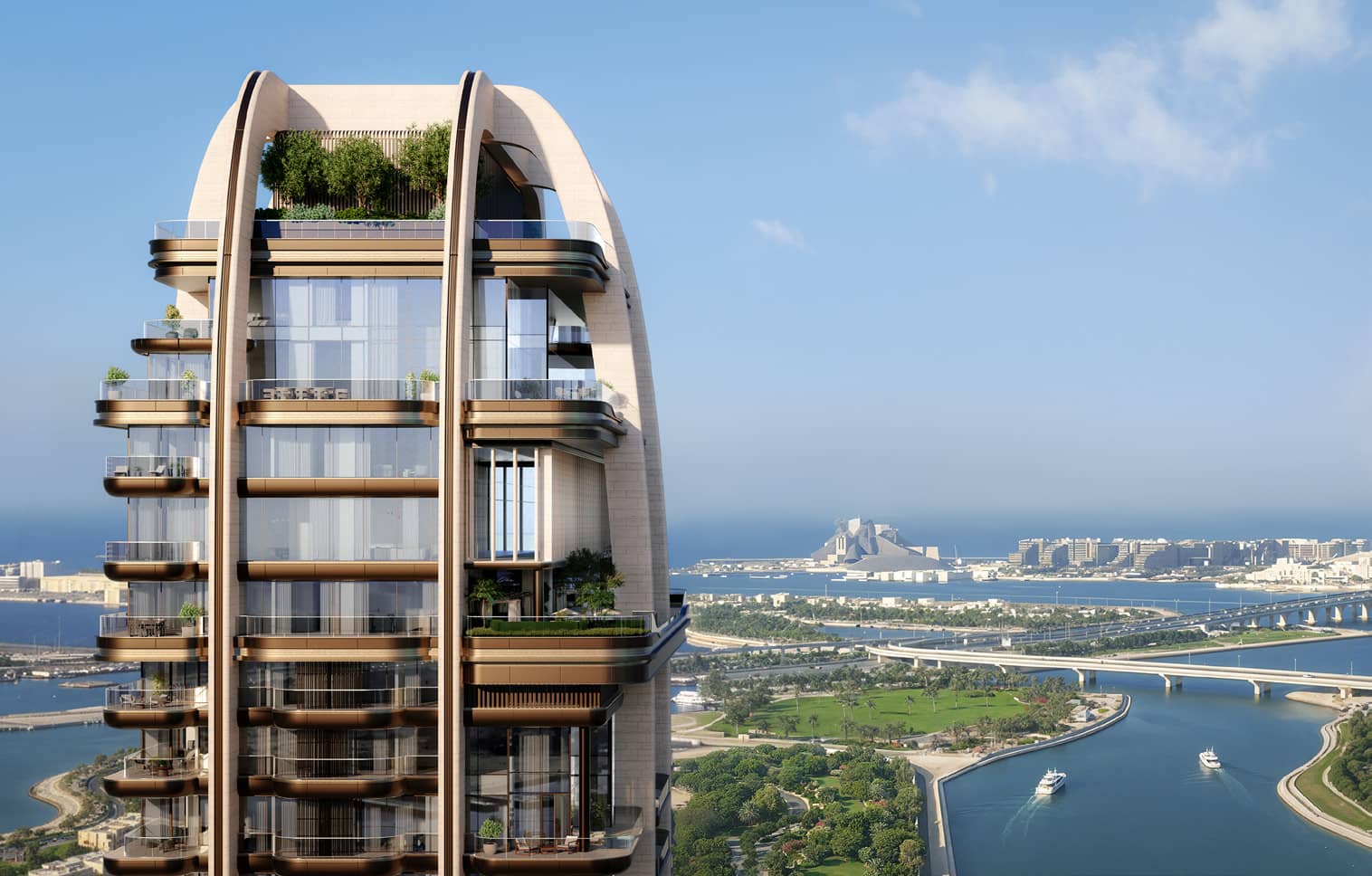
Interview with Noboru Toyama of YAMATO: Why Dubai Real Estate Is Chosen for Its Yields | A Comparison with Singapore and Hong Kong
If there is one phrase that captures the appeal of Dubai real estate, it is "high rental yields." Noboru Toyama, CEO of YAMATO CAPITAL, always highlights this point first when speaking to Japanese investors. Based on on-the-ground sentiment, the average net rental yield sits around 5% to 6%. When compared with financial hubs like Singapore and Hong Kong, it quickly becomes clear why Dubai's numbers are so frequently discussed.
This article first compares yields across these three major cities and then breaks down the three underlying reasons: lower unit prices per square meter, robust rental demand driven by population growth, and minimal tax-related costs.
First Look: Why Dubai's Yields Are Viewed as Higher Than Other Cities
As a practical benchmark from the field, Toyama points to Dubai's average net yield of around 5% to 6%. Public market reports present similar figures, placing Dubai distinctly above Hong Kong's official market yields and typical benchmark figures quoted for prime Singapore districts.
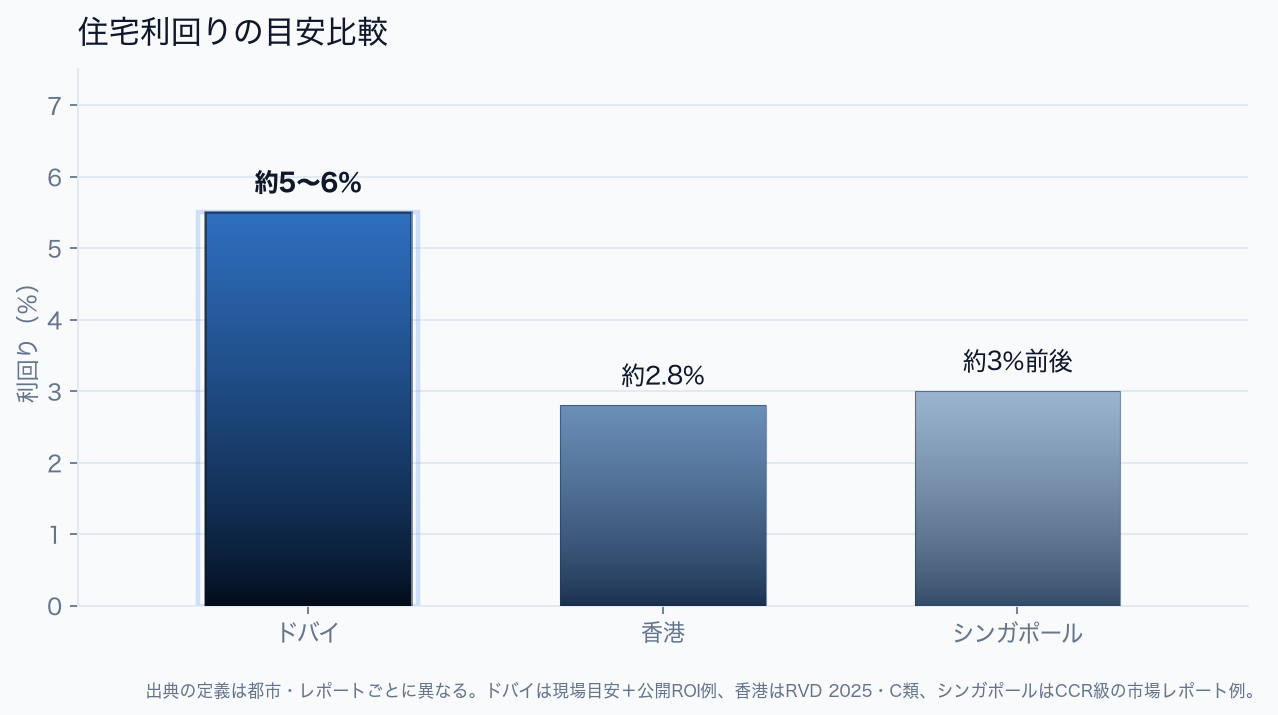
Chart: Indicative residential yields. Definitions vary across cities and reports. Dubai reflects field benchmarks and published ROI examples; Hong Kong reflects RVD market yields; Singapore reflects market reports for CCR-tier properties.
Because definitions and methodologies differ across reports, one cannot assume every individual unit will achieve these exact percentages. Nevertheless, the frequent citation of a 5% to 6% range in Dubai closely aligns with both published data and market reality.
Toyama also points out that in Singapore—where high Additional Buyer's Stamp Duty (ABSD) is levied on foreign buyers—the barrier to securing attractive net rental yields becomes significantly higher once upfront acquisition costs are factored in.
One crucial caveat must always be noted: the gap between gross yields (advertised rates) and net yields (take-home returns). After deducting service charges, vacancy periods, registration fees, and international remittance costs from Japan, the headline percentage does not translate directly into cash in hand. The following three sections explore the fundamental drivers behind these high yields.
Reason 1: Lower Price per Square Meter and Reduced Initial Acquisition Costs
At its core, rental yield is calculated as: Annual Rent ÷ Property Price. When property prices in the denominator are comparatively low, the yield percentage naturally rises for a given rental income. This difference in unit cost is the very first factor Toyama emphasizes when discussing Dubai's performance.
For a central 1-bedroom apartment, Toyama often cites a rule-of-thumb benchmark of approximately JPY 100 million (roughly USD 650,000 to 700,000) for 70 to 80 square meters, based on high-demand prime areas such as Downtown Dubai. Comparing a property of identical size to central Hong Kong or Singapore reveals a stark contrast in price per square meter.
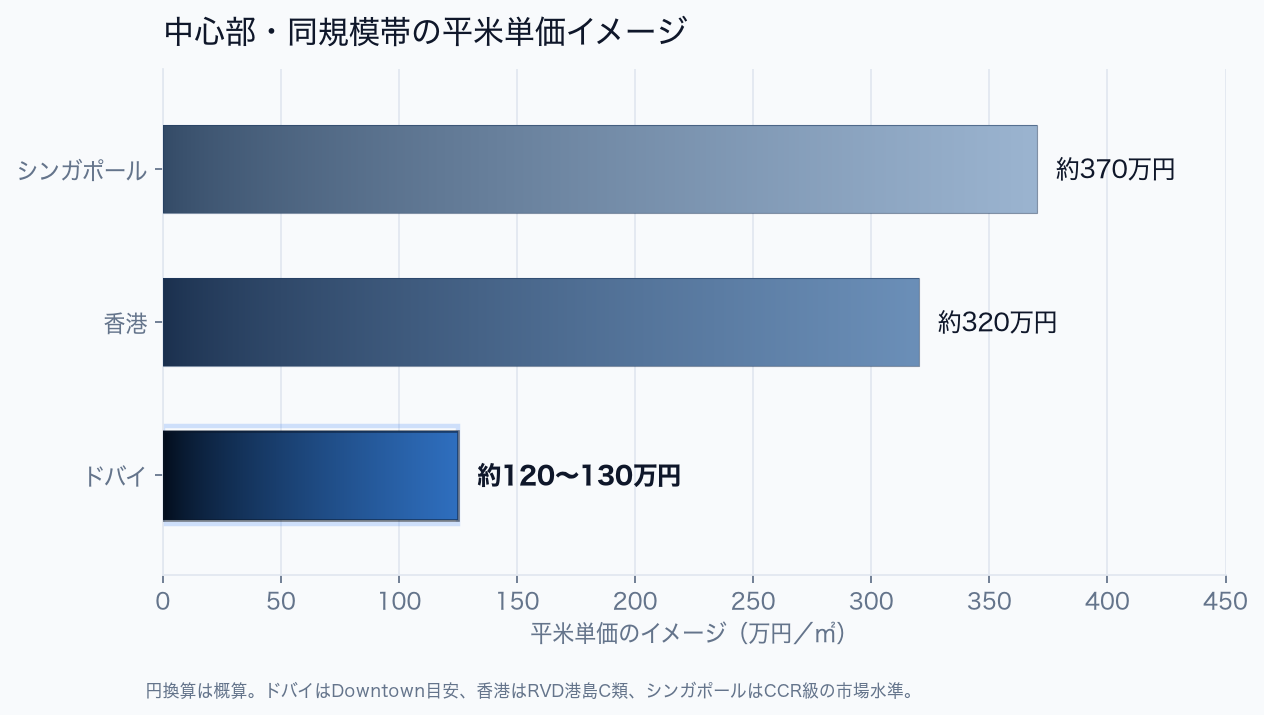
Chart: Illustrative price per square meter (approximate conversion). Dubai reflects Downtown benchmarks; Hong Kong reflects RVD Hong Kong Island data for comparable sizes; Singapore reflects prime CCR market levels.
For the exact same floor area, the initial capital commitment required is substantially lower. Consequently, the percentage yield appears significantly higher than in peer global cities—a point Toyama articulates straightforwardly. Because citywide averages sit below prime central districts, transaction data must be evaluated on an individual basis depending on neighborhood, layout, and completion status.
Reason 2: Rapid Population Growth Fueling Real Rental Demand
Even with a lower denominator, a high yield is merely theoretical if there are no tenants. The second element Toyama stresses is genuine rental demand underpinned by rapid demographic expansion. While often described to Japanese investors as "adding more than 100,000 residents a year," official statistics in recent years have shown growth outpacing even that figure.
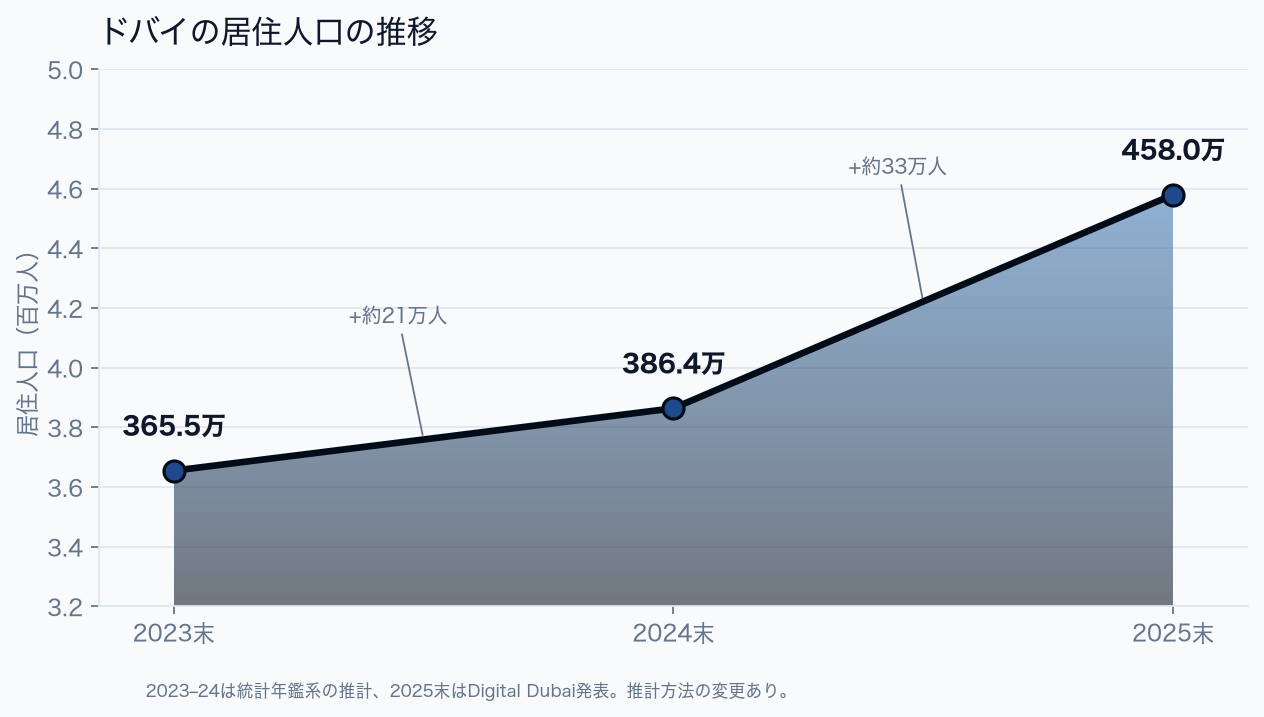
Chart: Trend in resident population. Recent years have seen annual increases well surpassing 100,000 residents, reflecting methodological revisions (Source: Digital Dubai Announcement, among others).
This population growth is tightly linked to long-term urban planning. Under the Dubai 2040 Urban Master Plan (dubai2040.ae), key objectives include massive population expansion, the restructuring of urban hubs, and significantly raising the proportion of residents living within walking distance of public transit. Toyama places significant weight on the emirate's strategy of pairing population targets with aggressive infrastructure development. Rather than focusing solely on short-term price appreciation, his approach prioritizes examining key transit nodes and strategic hubs. (Keep in mind that urban plans represent government targets, not guaranteed completions.)
Yet, a growing population does not mean every single property will instantly find a tenant. Toyama emphasizes that population growth can only translate into sustainable yields if you identify precisely which demographic will rent, in what neighborhood, and with what floor plan.
Reason 3: Minimal Tax Burden Protecting Net Returns from Erosion
Another pillar supporting strong yields is the minimal tax burden imposed at purchase and during ownership. This is a crucial distinction Toyama highlights whenever contrasting Dubai with Singapore and Hong Kong.
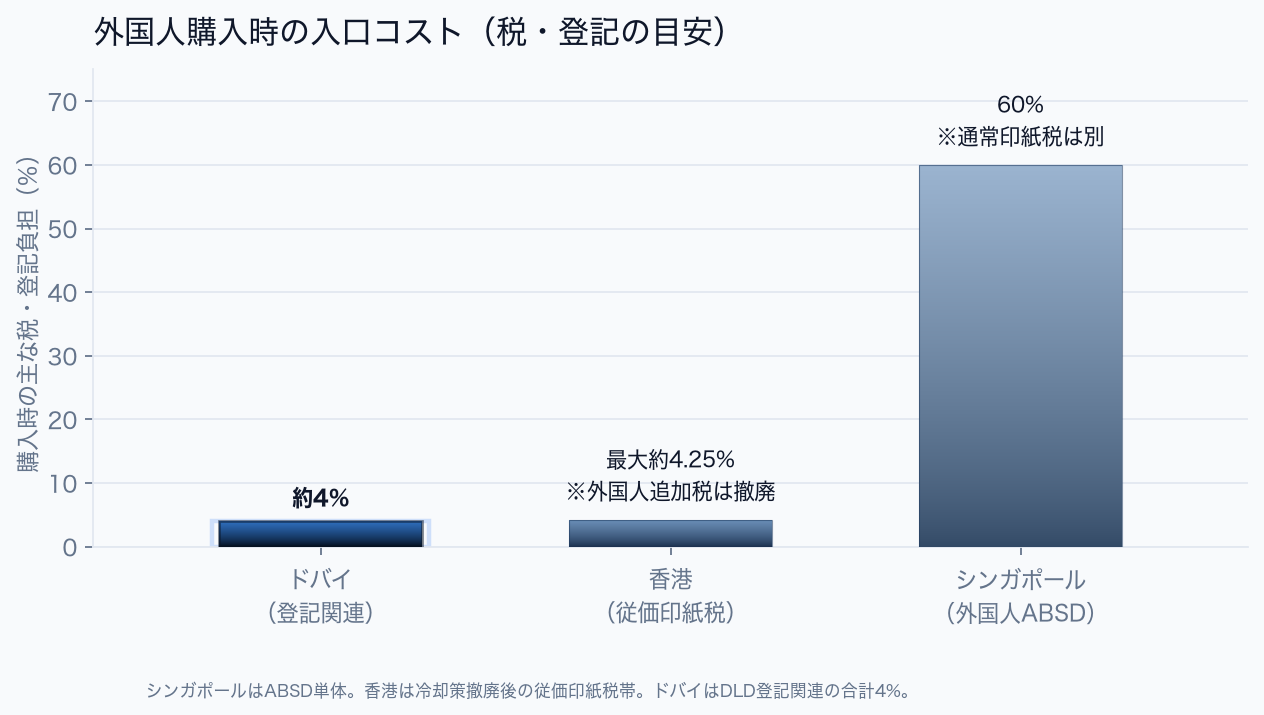
Chart: Indicative taxes and registration costs for foreign purchasers. Singapore centers on Additional Buyer's Stamp Duty (ABSD) for foreigners. Hong Kong operates under standard ad valorem stamp duty after the withdrawal of cooling measures. Dubai centers on Dubai Land Department (DLD) transfer fees, with no recurring annual property taxes, individual capital gains taxes, or personal income taxes.
This does not mean ownership is completely cost-free; ongoing operational expenses exist, including service charges and municipal housing fees paid by tenants. Nevertheless, because there is virtually no personal taxation on rental income or capital gains, Toyama notes that the gap between headline yields and net take-home cash flow remains comparatively narrow.
When upfront transaction taxes are heavy, the actual net return drops drastically even if rental income remains identical. Singapore's foreign buyer stamp duty is a textbook example. In Toyama's assessment: "While Hong Kong has become easier to enter again post-cooling measures, its price per square meter remains steep, keeping yields relatively compressed."
High Yields Are the Cumulative Result of Three Interlocking Factors
Dubai's reputation for high rental returns is not driven by hype, but by three concrete, structural dynamics: competitive square-meter acquisition pricing, genuine rental demand underpinned by demographic and urban planning tailwinds, and minimal tax/registration overhead upon purchase. The disparities shown in market data are the collective product of these three elements.
Toyama's core conclusion, however, is that investment decisions should never end with high-level city comparisons. Once an investor understands why Dubai yields are high, the next essential step is evaluating individual target properties: analyzing historical transaction prices, verifying projected rental assumptions, and factoring in service charges, vacancy allowances, registration fees, and currency remittance costs within the same financial model. Citywide comparisons open the door to interest; disciplined property-level due diligence determines the final decision.
For a comprehensive overview of property selection and the purchase process, please see our Dubai Real Estate Buying Guide.